

THE IRURI JOURNAL
ENGINEERING & DESIGN
A Roof Rack Shouldn’t Make the Wrangler Less Like a Wrangler.
Why Adding Capacity Above the Cabin Should Not Mean Giving Up the Freedom That Made the Roof Useful in the First Place.
A Design-Led Study on Mass, Airflow, and Functional Integration for Jeep Wrangler JL & 4xe Roof Platforms.
The roof is the most direct territory for vehicle expansion. When the rear cargo floor fills with refrigeration, tools, and camp gear, moving equipment upward feels natural. A roof rack adds volume. It provides physical mounting slots for storage cases, recovery tracks, and oversized items that cannot live inside the cabin. Yet every roof-mounted structure introduces an immediate series of trade-offs: mass placed at the highest point of the vehicle, surface area exposed to highway airflow, and potential interaction with the roof panels and access points beneath it. Roof capacity is easy to measure in dimensions and mounting slots. What a rack takes away from the vehicle experience is often much harder to see.

Jeep Wrangler Roof Platform: Low-Profile Aluminum Cargo System for JL & 4xe
Chapter 01: The Roof Is Not an Empty Platform
Vehicle roofs operate under physical limits. Dynamic roof load guidelines, vehicle center-of-gravity behavior, and suspension dynamics represent finite design considerations.
A roof rack does not provide weightless utility. Before the first storage box is strapped down, the rack's own material mass has already consumed a portion of that available overhead allowance.
Adding excessive mass high on the vehicle inherently influences center-of-gravity dynamics during directional changes and trail transitions.
A functional platform requires material restraint: structural support must be achieved without turning the vehicle’s roofline into an unnecessarily heavy superstructure.
Field Observation 01
The first thing a roof rack carries is its own structure.


Chapter 02: The Wrangler Roof Was Designed to Move
A Jeep Wrangler is fundamentally different from a conventional unibody SUV. It is defined by modularity: removable hardtop panels, removable doors, and open-air driving.
For that reason, Wrangler roof systems carry an additional responsibility: they are added to a vehicle whose roof was never conceived as a permanently closed surface. Freedom Panels, removable hardtop sections, and open-air driving make access itself part of the design equation.
When a rack permanently obstructs the roof underneath, cargo capacity is gained by sacrificing one of the primary reasons owners choose a Wrangler in the first place.
A roof system should expand what a vehicle can carry without converting an open platform into a closed van.
Chapter 03: Lower Is Better—Until It Gets in the Way
A low-profile silhouette is critical for visual cohesion and garage clearance. A platform that follows the roofline closely integrates with the vehicle's natural proportions.
However, lowering a structure too close to the hardtop creates practical limitations: hands cannot reach underneath to secure mounting brackets, strap ends cannot pass through slat channels, and trail debris becomes difficult to clear.
Good design is not about making a structure as thin as possible. It is about removing volume without removing access.
The perimeter framework should trace the hardtop contour closely, maintaining a low visual center while preserving the clearance necessary to operate attachment hardware.


Design Observation
Good packaging is not about making a structure as small as possible. It is about removing volume without removing access.
Chapter 04: Wind Is Part of the Design
A roof platform spends its working life moving through airflow at highway speeds.
Aerodynamics cannot be solved by appearance alone. The shape, spacing, and orientation of each structural element influence how air moves across the hardtop. That makes airflow a packaging consideration from the beginning, rather than something considered only after installation.
Structural packaging—such as contoured leading profiles and longitudinally aligned crossbars—helps manage the way air passes across the hardtop surface.
As with any exterior roof accessory, additional wind noise can vary with vehicle speed, weather conditions, and the specific equipment mounted above.

Field Observation 02
A roof rack is easy to judge while the vehicle is parked. The harder test begins once the vehicle starts moving.
Chapter 05: Capacity Should Be Organized, Not Just Added
A roof platform should not behave like an open basket where gear is loosely accumulated. It should function as an organized upper deck.
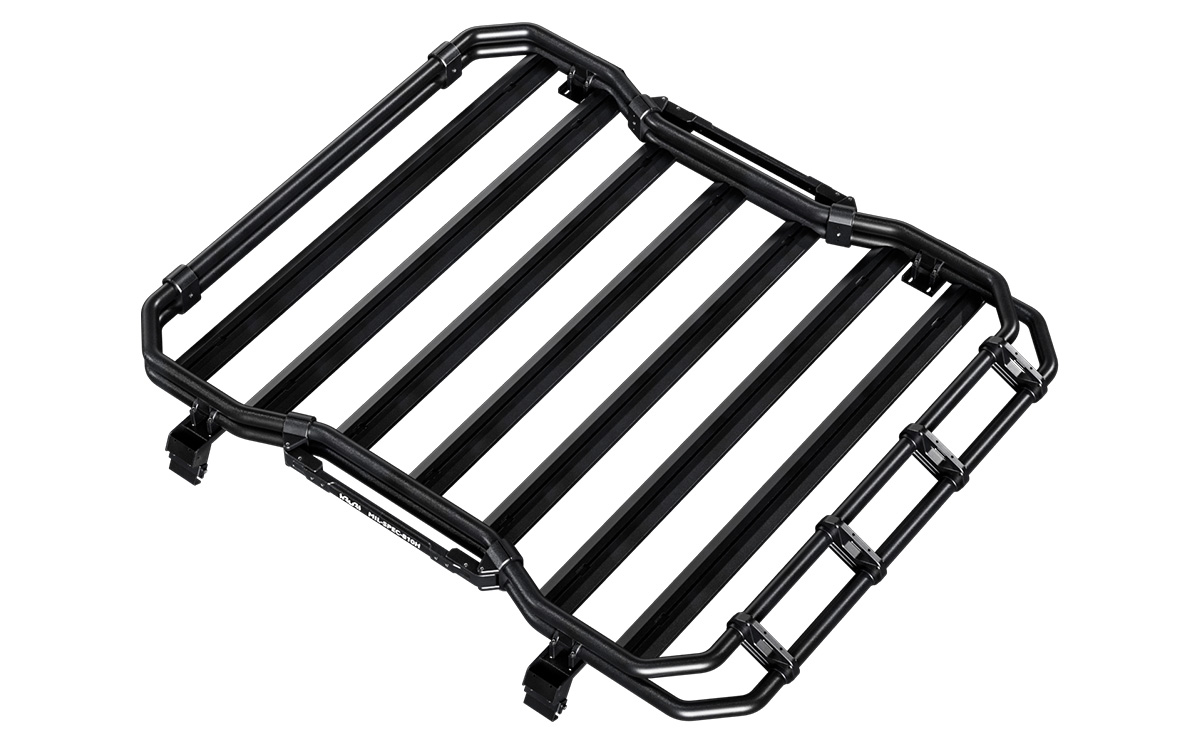
The IRURI Dual-Layer Roof Platform establishes a defined layout across the hardtop:
• Perimeter Rail Layout: The tubular perimeter framework defines cargo boundaries and provides stable tie-down attachment points.
• Dual-Layer Organization: Creates distinct zones to help separate larger primary cases from secondary trail gear.
• Crossbar Accessory Channels: Integrated channels running along the crossbars accept standard hardware, simplifying the mounting of cargo cases, recovery boards, and lighting mounts.


Product Resolution
The IRURI Dual-Layer Roof Platform translates these functional priorities into a vehicle-specific physical asset:
• High-Strength Aluminum Alloy: Constructed from aluminum alloy to balance load support within a total system weight of 27 kg.
• Proportions: Engineered at 1659 × 1509 × 226 mm to follow the hardtop proportions of the Jeep Wrangler JL.
• Factory-Location Mounting: Uses a factory bolt-on mounting approach designed for existing factory hardtop mounting locations, requiring zero vehicle drilling.
• Industrial Coating: Finished in a matte black industrial coating intended for exterior environmental exposure.


Use Observation
At camp, equipment stored above the vehicle eventually needs to be accessed, unpacked, or secured.
With a structured crossbar layout and accessible perimeter rails, securing gear becomes an orderly routine rather than a complex balancing act around the roofline.
The goal was never to add more metal to the Wrangler. It was to make the space above it truly useful.
Field Principle
A modification should expand what a vehicle can do, not change what made it special.
People often evaluate a roof rack by how much gear can be mounted on top. The more important question is: How much of the vehicle’s original utility is preserved?
A Wrangler was designed to remain versatile, modular, and open. Adding overhead capability should complement those characteristics, not work against them. The goal was never simply to add structure above the cabin. It was to make that space purposeful, manageable, and integrated with the way owners actually travel. Add capability. Keep the vehicle.
Frequently Asked Questions
Does the IRURI Dual-Layer Roof Platform require drilling into the Jeep hardtop?
No. The platform uses a factory bolt-on design engineered to install into factory roof mounting locations with no vehicle drilling required.
No. The platform uses a factory bolt-on design engineered to install into factory roof mounting locations with no vehicle drilling required.
Which Jeep Wrangler models are compatible with this roof platform?
It is engineered specifically for Jeep Wrangler JL hardtop models (2019–Present), including Rubicon and applicable 4xe models.
It is engineered specifically for Jeep Wrangler JL hardtop models (2019–Present), including Rubicon and applicable 4xe models.
What are the dimensions and total weight of the platform assembly?
The overall dimensions are 1659 × 1509 × 226 mm with a total system weight of 27 kg.
The overall dimensions are 1659 × 1509 × 226 mm with a total system weight of 27 kg.
Does the roof platform introduce additional wind noise?
Some additional wind noise may occur depending on vehicle speed, weather conditions, and the specific cargo accessories mounted.
Some additional wind noise may occur depending on vehicle speed, weather conditions, and the specific cargo accessories mounted.
Can outdoor accessories be mounted directly to the platform?
Yes. The integrated crossbar mounting channels are designed to accommodate compatible cargo and outdoor accessory hardware.
Yes. The integrated crossbar mounting channels are designed to accommodate compatible cargo and outdoor accessory hardware.
What tools are required for installation, and how long does it take?
Installation requires a torque wrench, metric socket set, and hex keys, taking approximately 120 minutes. Due to the physical size of the assembly, two-person installation is recommended.
Installation requires a torque wrench, metric socket set, and hex keys, taking approximately 120 minutes. Due to the physical size of the assembly, two-person installation is recommended.
| Engineering Anchor | System Specification Details |
|---|---|
| Vehicle Compatibility | Jeep Wrangler JL hardtop models (2019–Present), including Rubicon and applicable 4xe models |
| Material Architecture | High-Strength Aluminum Alloy |
| Surface Finish | Matte Black Industrial Coating |
| System Weight | 27 kg |
| Dimensions | 1659 × 1509 × 226 mm |
| Installation Protocol | Factory Bolt-On (No Drilling Required) |
| Estimated Install Time | Approximately 120 minutes (Two-Person Installation Recommended) |
| Installation Difficulty | Intermediate |
| Required Tools | Torque Wrench, Metric Socket Set, Hex Keys |
A modification should expand what a vehicle can do, not change what made it special.
Explore the Full-Circle Roof Platform engineered for Jeep Wrangler JL & 4xe hardtops.
Explore the Jeep Roof Platform →
0 comments