

THE IRURI JOURNAL
BRONCO ARCHITECTURE SYSTEM
A Bronco Should Work as One System.
A Modular Approach to Movement, Access, Cargo, Rest, and Basecamp Utility.
How Ford Bronco accessories for roof access, cockpit control, cargo organization, sleeping, and basecamp utility can work as one system.
The sixth-generation Ford Bronco was designed around modularity. With removable doors, a convertible roof structure, and dedicated mounting points, it invites personalization. Yet when accessories are added in isolation—a rack here, a shelf there, a device mount on the windshield—the vehicle can gradually become heavier, more cluttered, and harder to use as a whole. True capability does not come from accumulating parts. It comes from building a system where every component understands the vehicle, the journey, and the human inside.

01 / When Accessories Stop Working Together
Every adventure build begins with a series of immediate upgrades. An owner adds a roof rack for extra gear, installs auxiliary lighting, bolts a storage system into the rear cargo area, and secures device mounts across the cockpit. Individually, each component addresses a specific need. Collectively, they can begin competing with each other.
Roof-mounted gear can become awkward to reach without dedicated access points. Fixed drawer systems can trade vertical flexibility for enclosed organization. Cockpit accessories can clutter forward sightlines and vibrate across washboard roads. When components are treated as isolated accessories rather than an integrated architecture, the vehicle gains complexity, while simple camp tasks become frustratingly difficult.
Capability should accumulate. Complexity should not.
02 / From Accessories to Architecture
What turns a collection of aftermarket accessories into a cohesive vehicle architecture? In the IRURI design philosophy, integration requires three foundational principles:
• Shared Geometry: Every component is engineered specifically around the factory dimensions, body clearances, and ergonomic sightlines of the Ford Bronco.
• Shared Mounting Logic: Where the vehicle architecture allows, IRURI prioritizes factory mounting points, reversible installation, and minimal permanent modification.
• Shared Utility: Components are engineered to serve multiple roles across the trip. A grab handle stabilizes passenger posture and anchors navigation devices; a rear cargo platform stratifies storage and redeploys as a field workstation.
A component earns its place when it solves more than one moment of the journey.


03 / One Vehicle. Five States.
An expedition is not a static scenario. It moves through an operational rhythm: MOVE → REACH → ORGANIZE → REST → LIVE → MOVE AGAIN. The IRURI Bronco Architecture System organizes vehicle capability across five defined human states:
| Vehicle State | Human Need | Architecture System |
|---|---|---|
| MOVE | Dynamic Stability, Posture & Navigation Access | Cockpit Interface |
| REACH | Predictable Vertical Access to Roof Storage | Roof Architecture |
| ORGANIZE | Stratified Cargo, Visibility & Tool Access | Cargo Architecture |
| REST | Continuous Level Surface & In-Cabin Recovery | Interior Rest Architecture |
| LIVE | Field Workstations, Task Lighting & Basecamp Life | Basecamp System |
MOVE: The Cockpit as a Human Interface
During rough-road movement, passengers naturally look for a rigid and predictable point of support—something soft trim and general interior surfaces do not always provide.
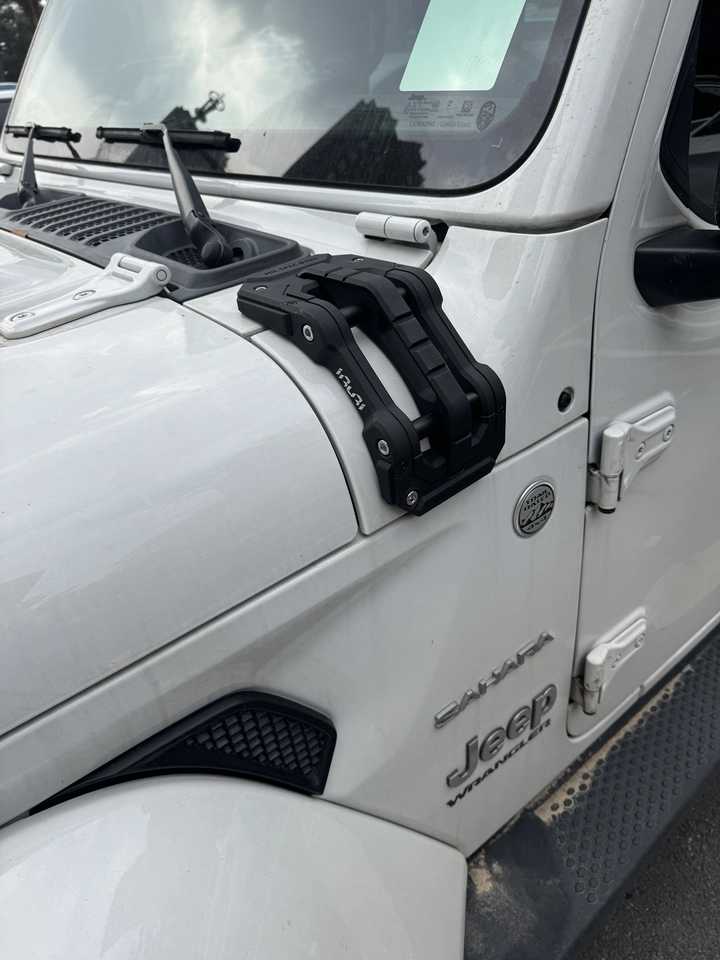
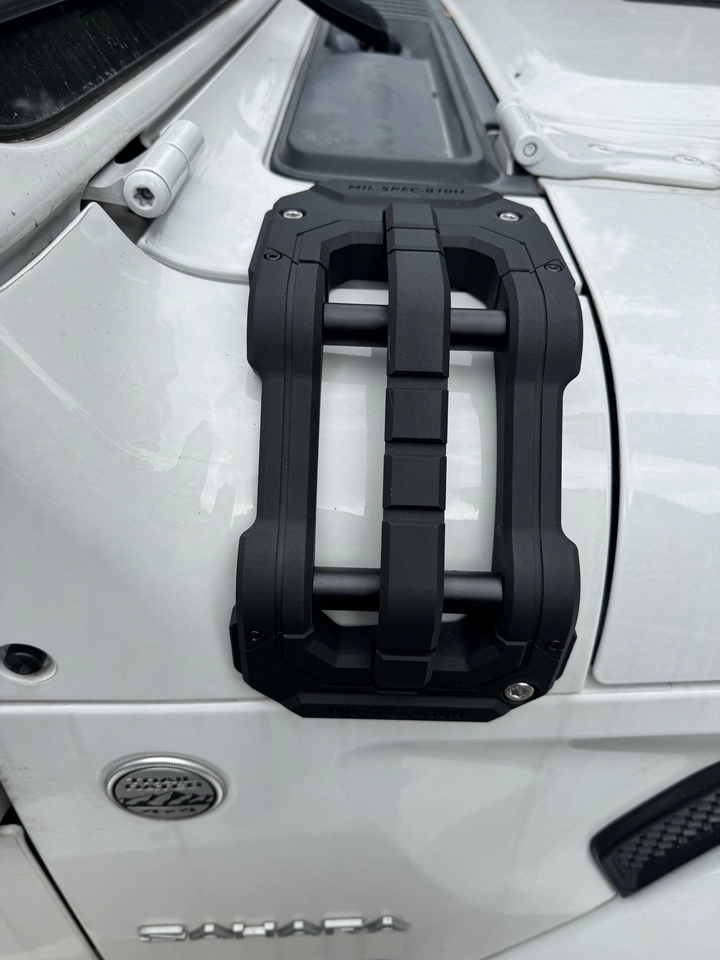
The IRURI Ford Bronco cockpit interface secures to factory mounting locations, providing a rigid, predictable gripping point during rough-road movement. Machined from solid aluminum alloy, the handle incorporates a dedicated modular mounting receiver on the top crown, positioning GPS tablets, smartphones, and communications within natural peripheral reach below the forward sightline. Paired with a direct-replacement center console armrest upgrade, it creates a more stable and predictable contact point during long periods of rough-road travel.
The cockpit is where vehicle capability becomes human experience.


REACH: When Capability Moves Upward
As gear requirements expand, equipment naturally migrates to the roof. However, mounting storage cases, recovery boards, or rooftop tents creates an access challenge: overhead volume is only useful if you can comfortably reach it from ground level.
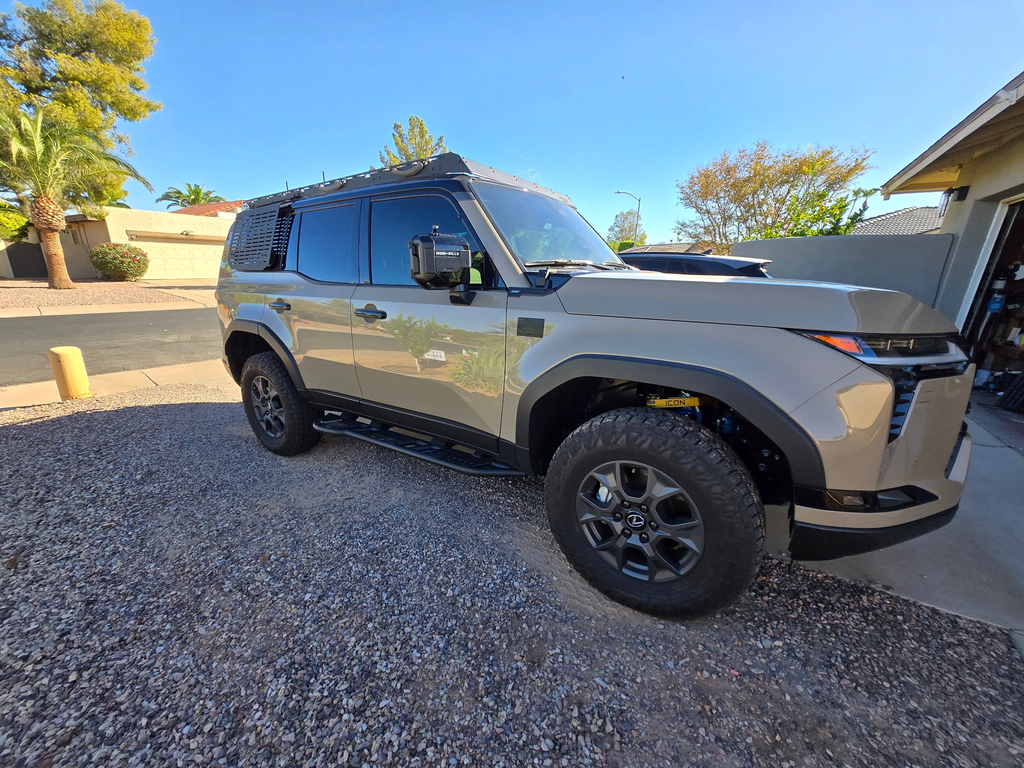
The IRURI modular roof rack is engineered around factory hardtop mounting geometry, utilizing dedicated rail clamps to secure overhead cargo without drilling into the roof skin, while maintaining spatial clearance for front Freedom Panel operation. Combined with the contoured Ford Bronco side ladder, it establishes a dedicated vertical path between the ground and roof storage, turning an awkward climb into a repeatable interaction.
Storage does not become useful simply because it can be mounted above you.

ORGANIZE: Volume Is Not Organization
A single flat cargo floor offers volume, but without vertical division, gear inevitably piles up. Recovery straps, tool rolls, and emergency kits get trapped underneath heavy refrigeration units and camp duffels, forcing owners to unload the vehicle just to retrieve essential items.
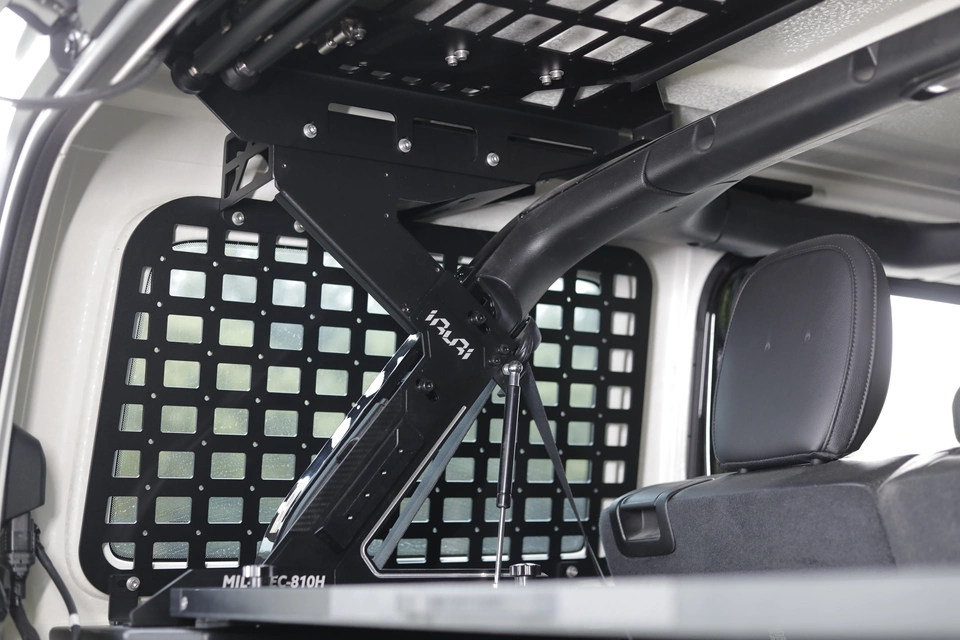
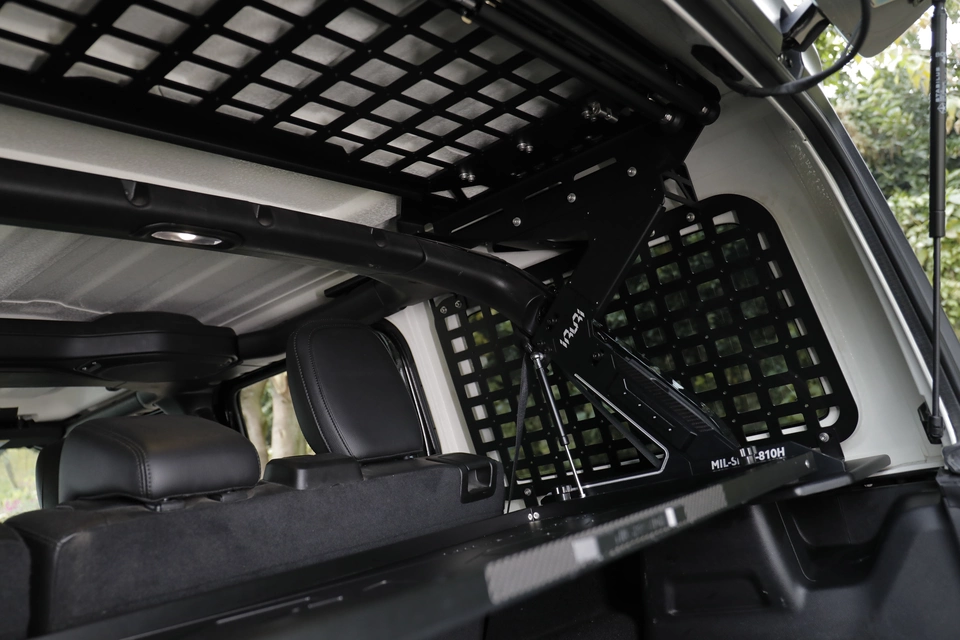
The IRURI Bronco modular cargo platform stratifies rear space into independent functional tiers. Its upper platform is rated for a 150 kg static load, while side laser-cut MOLLE panels keep critical tools indexed along the wheel wells. Because the platform frame is elevated above the floor, the factory sub-floor cargo compartment remains accessible without disassembling the system.
Volume is passive. Organization is active.


REST: When the Bronco Stops Moving
When an overland journey extends overnight, the interior must shift roles. Folding down the Bronco's rear seats leaves a slight height ridge, making in-cabin rest uneven without dedicated leveling architecture.
The IRURI Bronco sleep platform creates a continuous, flat sleeping deck tested for over 300 kg of static load across the folded seats. By preserving usable storage space beneath the sleeping surface, travel gear stays organized and dry inside the vehicle, allowing owners to rest without shifting luggage out into the mud or rain.
When a Bronco stops moving, its interior begins another job.

LIVE: After Arrival
Arrival is where the vehicle shifts from transportation into a basecamp. Camp meal preparation, tool maintenance, and camera staging require stable, elevated working surfaces and clean task illumination.
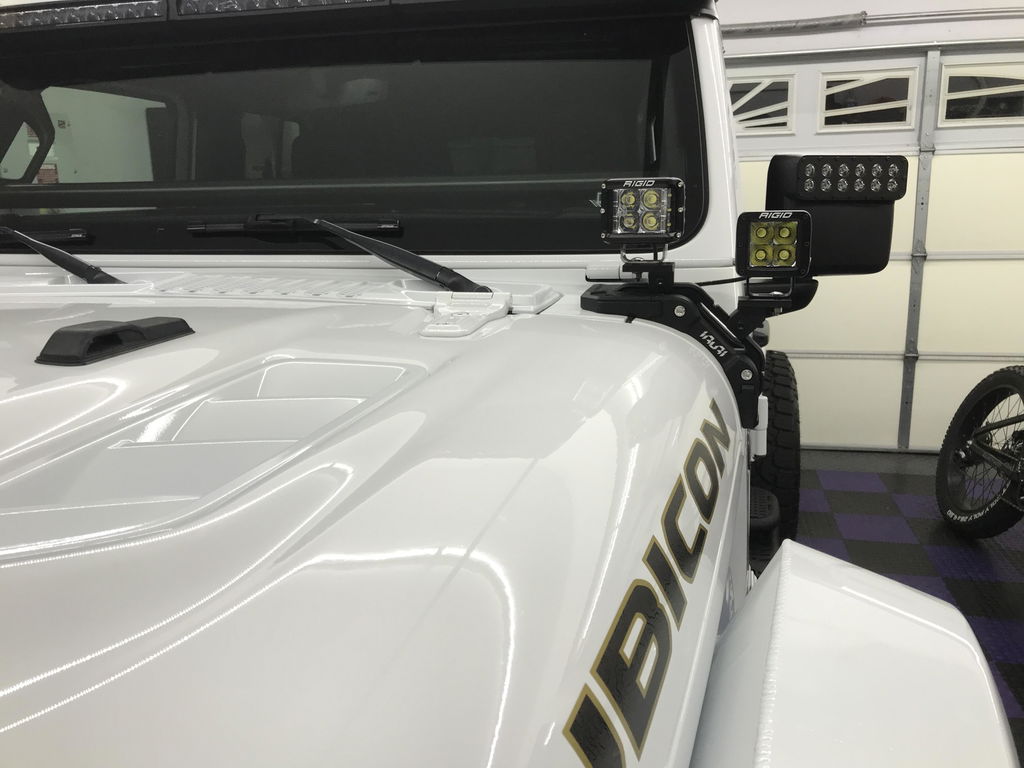
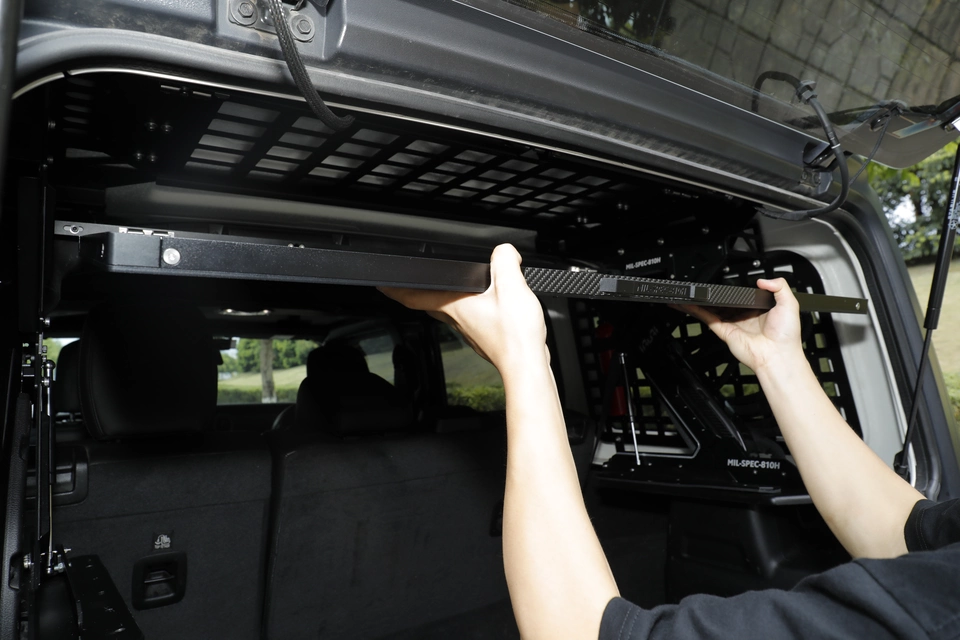
The middle tier of the Bronco modular cargo platform is engineered to detach and redeploy outside the vehicle as a standalone camp table and field workstation. Meanwhile, hidden-wiring A-pillar light brackets provide peripheral campsite illumination around the vehicle perimeter without exposed wiring clutter.
The goal is not to turn the Bronco into a house. It is to remove friction between movement and living.


Read the Cargo & Workstation Journal → Read the Basecamp Lighting Journal → Explore A-Pillar Lighting Brackets →
Field Observation
A vehicle becomes more capable not when more parts are added, but when every part begins to work together.
Four Rules Behind the System
01 — Respect the Factory Vehicle: Design around original Ford Bronco mounting points and structural paths without unnecessary sheet-metal modification.
02 — One Part, More Than One Job: Every component must justify its space by serving multiple operational requirements across the trip.
03 — Capability Without Clutter: Clean internal wire channels, low-profile brackets, and contoured forms prevent visual noise inside and outside the vehicle.
04 — Design for the Entire Journey: Design decisions should consider the vehicle across transit, trail use, packing, stopping, and camp life—not only while it is moving.
Build by Need, Not by Checklist
There is no universal Bronco build sequence. Rather than following a generic catalog checklist, structure your build around the practical constraint you encounter most often:
• If passenger stability and navigation access are the bottleneck → MOVE: Upgrade cockpit contact points with rigid grab handles and central device mounts.
• If overhead cargo volume and reach are the bottleneck → REACH: Install a modular roof rack and contoured side ladder for high-volume gear access.
• If rear clutter and tool access are the bottleneck → ORGANIZE: Stratify the trunk area with a multi-tier cargo platform and side MOLLE panels.
• If self-contained backcountry rest is the priority → REST: Integrate a continuous in-cabin sleeping deck over folded rear seats.
• If campsite setup and workspace efficiency matter → LIVE: Deploy task lighting and detachable field workstations to support campsite setup and field use.
Build according to the way you use the Bronco, not according to how many accessories you can fit onto it.
The IRURI Bronco Architecture System
01
MOVE — Cockpit Interface
CNC-machined aluminum grab handles and armrests engineered for passenger trail stabilization and central device mounting.
Explore Cockpit Interface →
02
REACH — Roof Architecture
Modular roof racks and contoured side access ladders engineered for predictable ground-to-roof gear reach.
Explore Roof Architecture →
03
ORGANIZE — Cargo Architecture
Multi-tier rear cargo platforms with side MOLLE grids and a 150 kg static load rating to eliminate trunk clutter.
Explore Cargo Architecture →
04
REST — Sleep Architecture
Continuous flat in-cabin sleeping decks tested for over 300 kg of static load with preserved under-platform storage.
Explore Sleep Architecture →
05
LIVE — Basecamp Utility
Detachable field workstations and hidden-wiring A-pillar light brackets for seamless campsite deployment.
Explore Basecamp Utility →Frequently Asked Questions
What are the most useful Ford Bronco accessories?
The most effective upgrade depends on what currently limits the vehicle: access, cargo organization, passenger stability, sleeping space, or camp utility. Selecting components that integrate into a shared architecture can reduce redundant hardware, duplicated functions, and space conflicts.
The most effective upgrade depends on what currently limits the vehicle: access, cargo organization, passenger stability, sleeping space, or camp utility. Selecting components that integrate into a shared architecture can reduce redundant hardware, duplicated functions, and space conflicts.
What should I upgrade first on a Ford Bronco for overlanding?
Start with the problem you encounter most often. If trail driving causes passenger fatigue, start with cockpit stabilization. If camp gear gets disorganized, address cargo stratification before adding heavy exterior equipment.
Start with the problem you encounter most often. If trail driving causes passenger fatigue, start with cockpit stabilization. If camp gear gets disorganized, address cargo stratification before adding heavy exterior equipment.
How do you organize a Ford Bronco for camping?
Use vertical spatial layering: keep heavier equipment low, separate frequently used gear from bulk storage, and place quick-access items on dedicated side MOLLE panels.
Use vertical spatial layering: keep heavier equipment low, separate frequently used gear from bulk storage, and place quick-access items on dedicated side MOLLE panels.
Does a Bronco need a roof rack for overlanding?
Not every Bronco needs a roof rack. It becomes useful when bulky or low-frequency gear begins competing with passenger and cargo space inside the vehicle. For frequently accessed roof cargo, a dedicated access solution such as a side ladder can make the system significantly easier to use.
Not every Bronco needs a roof rack. It becomes useful when bulky or low-frequency gear begins competing with passenger and cargo space inside the vehicle. For frequently accessed roof cargo, a dedicated access solution such as a side ladder can make the system significantly easier to use.
What is the difference between a Bronco cargo system and a sleep platform?
A cargo platform stratifies the rear trunk area behind the second-row seats for daily storage and field gear organization; a sleep platform extends across folded seats to create a continuous flat sleeping surface for overnight rest.
A cargo platform stratifies the rear trunk area behind the second-row seats for daily storage and field gear organization; a sleep platform extends across folded seats to create a continuous flat sleeping surface for overnight rest.
Can IRURI Bronco accessories be installed without drilling?
Many IRURI Bronco components are designed around factory mounting locations and require no drilling. Installation methods vary by product, so fitment and installation details should always be checked on the individual product page.
Many IRURI Bronco components are designed around factory mounting locations and require no drilling. Installation methods vary by product, so fitment and installation details should always be checked on the individual product page.
Build the System, Not the Collection.
A capable Bronco does not need more accessories simply for the sake of having more. It needs fewer, better-considered components that understand the vehicle, the journey, and each other. That is the philosophy behind the IRURI Bronco Architecture System.
EXPLORE THE IRURI BRONCO ARCHITECTURE SYSTEM
Engineered around movement, access, organization, rest, and basecamp utility.
EXPLORE BRONCO →
0 comments