

THE IRURI JOURNAL
ENGINEERING & DESIGN
The Bronco Was Built to Explore. We Asked What Happens After You Arrive.
Re-engineering the Rear Cargo Architecture of the 4-Door Ford Bronco
An Ergonomic Study on Rear Cargo Workflows, Vertical Stacking, and Modular Basecamp Integration (2021+).
The 4-door Ford Bronco was engineered to move beyond ordinary roads and into places most vehicles never reach. Yet every overland expedition inevitably transitions from the kinetic momentum of the trail to the stillness of arrival. When the engine cuts out at camp, a completely different spatial challenge begins: recovery cases are buried beneath coolers, daily tools are scattered, and the cargo area resembles a chaotic storage locker rather than a functional vehicle. Storage only solves where equipment lives. A true expedition system must also solve how equipment is used.

Why Does the 4-Door Ford Bronco Need Dedicated Rear Cargo Architecture?
Chapter 01: The Stack Problem: When Cargo Volume Becomes Chaos
The factory cargo floor of the 4-door Ford Bronco offers generous cubic capacity, but cubic volume without vertical division leads directly to operational friction on the trail.
During multi-day backcountry travel, gear naturally settles into vertical piles: soft duffels and sleeping bags get crushed underneath heavy plastic tool cases, while recovery straps and first-aid kits end up trapped beneath bulky coolers. Loose bins slide and rattle across washboard roads, scuffing interior wheel well trim.
Improvised solutions like generic plastic tubs or soft organizer bags only treat the symptoms. They consume usable headroom, slide under hard braking, and fail to utilize the vertical space along the Bronco's rear quarter panels. A flat floor provides volume, but real field efficiency requires structural organization.
Field Observation 01
Storage gets you there. Architecture helps you stay there.


Chapter 02: Spatial Stratification: The Logic of Vertical Cargo Layering
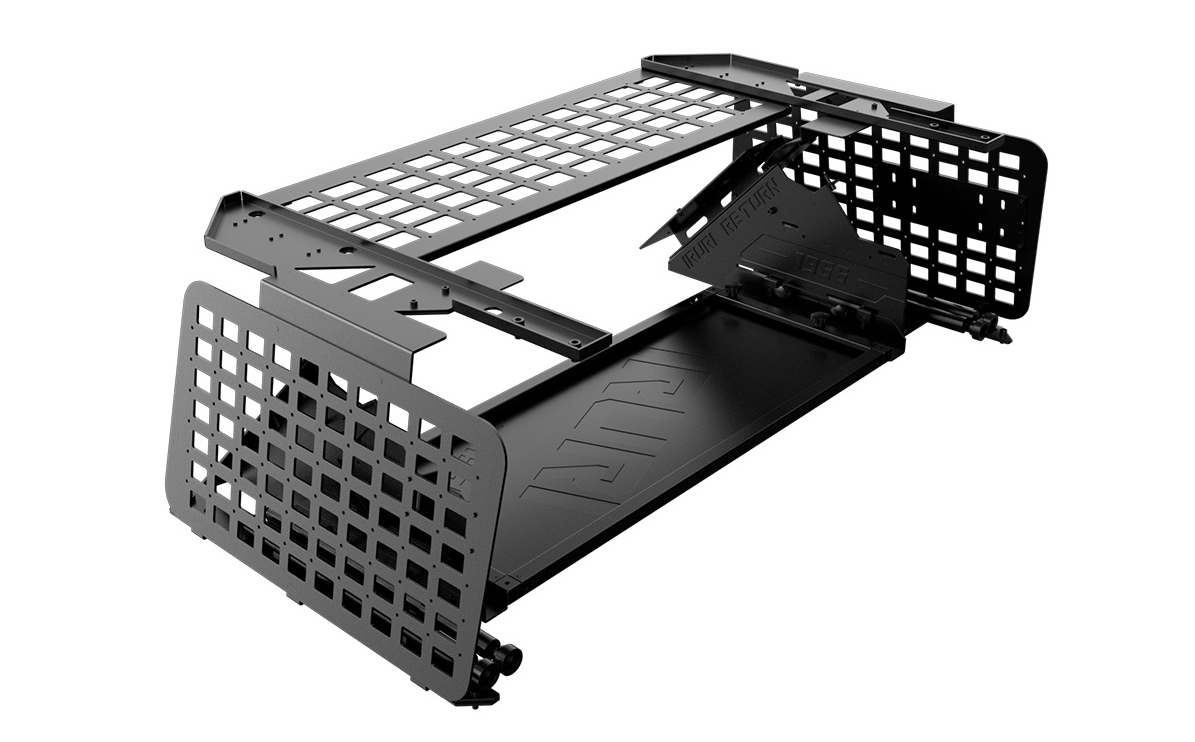
Conventional cargo upgrades often settle for a simple fixed shelf that limits loading flexibility. At IRURI, we redesigned the rear cargo zone as an integrated spatial architecture centered around three core requirements:
• Vertical Cargo Layering: By introducing an upper structural lattice deck and a rigid middle shelf, heavy cases and soft gear occupy dedicated levels, eliminating crushing and gear clutter.
• Immediate Tool Indexing: Emergency gear, fire extinguishers, and recovery tools mount along the vertical sidewalls, remaining instantly accessible the moment the rear swing gate opens.
• Preserved Under-Floor Access: The elevated framework leaves the factory cargo floor entirely clear, ensuring full, unobstructed access to the sub-floor tool compartment.
Unlike traditional cargo organizers that disappear into the background once the vehicle stops, the IRURI platform continues to create value throughout the entire journey.
Chapter 03: From Cargo Structure to Camp Architecture
The most elegant industrial design serves multiple critical functions across different phases of travel. The middle tier of the IRURI Modular Cargo Platform is not merely a passive divider. Embossed with the signature IRURI 1966 mark, this structural plate is engineered with a modular release architecture that transforms its identity between transit and basecamp life:
• Phase 01 / Driving Mode: Locked inside the chassis frame, it functions as a rigid horizontal divider that supports stacked luggage, distributes weight evenly, and prevents cargo shifts over rough terrain.
• Phase 02 / Basecamp Mode: Once parked, the middle tier can be quickly detached from the cargo system and redeployed outside the vehicle as a standalone camp table and field workstation—providing an elevated, heavy-duty surface for camp culinary prep, stove setups, mechanical tool staging, or camera rigging.
Instead of hauling a separate, bulky folding table that robs interior cargo space, your primary interior divider seamlessly becomes your field workstation.


From the Notebook
A good vehicle platform does not just carry gear to a destination; it transforms the vehicle into a responsive, organized basecamp the moment you arrive.
Chapter 04: Turning Unused Space into Active Storage: Integrated Side MOLLE & Top Grid
Dead space along the rear side windows and roll cage uprights is often completely neglected. IRURI transforms these structural boundaries into active, heavy-duty utility zones:
• Heavy-Duty Top Grid Deck: Features precision laser-cut structural lattice cutouts, providing continuous tie-down points for cam straps, bungee nets, sleeping bags, and soft travel duffels.
• Dual Side Tactical MOLLE Wings: Flanking both interior walls, the integrated steel MOLLE panels accept standard tactical pouches, quick-release axe/shovel clamps, first-aid kits, and flashlight holsters.
• Multi-Position Height Adjustability: Side mounting columns allow the mid-tray to be set at different height positions depending on whether you are carrying low-profile gear boxes or taller overland coolers.

Chapter 05: Hybrid Structural Engineering: Strength Without Dead Weight
Traditional enclosed drawer solutions often prioritize closed storage over flexibility. In practice, heavy steel drawer boxes add massive dead weight (often exceeding 60–80 kg), permanently consume vertical height, and create fixed layouts that cannot adapt to changing cargo sizes.
IRURI chose an open hybrid architecture built from lightweight aluminum panels paired with high-tensile steel mounting brackets:
• 150 kg Static Vertical Load Capacity: Confidently carries heavy overland gear boxes, fuel cans, and recovery tools across severe terrain without flex or chassis creaks.
• Anti-Rattle Mechanical Tolerances: Every connection uses counter-sunk hardware and precision mounting tabs to ensure completely silent performance on the trail.
• Industrial Matte Black Powder Coat: Bead-blasted and coated with an abrasion-resistant finish that repels scratches, mud, and trail grit.
Chapter 06: Designed Around Real Bronco Use Cases
Most Bronco owners live multi-faceted lives—transitioning between daily work, weekend adventures, and remote wilderness expeditions. The platform is engineered to serve each phase seamlessly:
• The Daily Driver: The upper tier keeps groceries, sports gear, and work cases separated from daily vehicle tools stowed neatly below.
• The Weekend Overland Run: Heavy recovery tools bolt directly to the side MOLLE panels, while camping gear remains anchored securely on the main deck.
• The Basecamp Setup: The moment the swing gate opens, all camp equipment is immediately visible at standing height, and the middle tray detaches to become your field workstation in seconds.


Field Observation 02
Real overland efficiency is not measured by how much you can pack, but by how effortlessly you can deploy it in the wild.
Chapter 07: Non-Invasive Packaging: Zero Drilling, Bolt-On Install
Permanent interior modifications damage vehicle value and introduce rattles over time. The IRURI Modular Cargo Platform is engineered strictly around factory hardpoints inside the Ford Bronco:
• Factory Bolt-On Protocol: Anchors directly into factory floor tie-down loops and upper chassis structural mounting points.
• Zero Interior Modifications: No drilling, cutting, or gluing required.
• 100% Reversible: Can be completely uninstalled to return the vehicle to stock condition without leaving a single trace.
Installation takes approximately 60–90 minutes with standard metric hand tools, delivering a solid, factory-integrated fitment.
Chapter 08: The IRURI Bronco Ecosystem: Architectural Harmony
Across the IRURI Journal series, every component solves a defined spatial challenge: the Roof Platform expands exterior access; the Cockpit Grab Handle secures human balance; the Sleep Platform enables backcountry rest; and the Modular Cargo Platform establishes permanent order in the rear cabin. We build cohesive interior and exterior interfaces designed to transform the Bronco into an integrated expedition tool.
A Bronco is not only built for the journey. It must be designed for the moments after you stop.
From overhead roof platforms to interior modular interfaces and rear cargo architecture, IRURI designs every component around one single conviction: every unused surface of your vehicle has the potential to become useful.
Frequently Asked Questions
Does this cargo system fit the 2-Door Ford Bronco?
This system is engineered specifically for the floor geometry, roll bar spacing, and mounting locations of the 2021+ Ford Bronco 4-Door platform. It is not compatible with 2-Door Bronco models or the Bronco Sport crossover.
This system is engineered specifically for the floor geometry, roll bar spacing, and mounting locations of the 2021+ Ford Bronco 4-Door platform. It is not compatible with 2-Door Bronco models or the Bronco Sport crossover.
How does the middle tray convert into a standalone field workstation?
The middle IRURI 1966 structural tray is engineered for quick removal from the modular frame. When parked, it can be detached and redeployed outside the vehicle as a standalone camp table and field workstation.
The middle IRURI 1966 structural tray is engineered for quick removal from the modular frame. When parked, it can be detached and redeployed outside the vehicle as a standalone camp table and field workstation.
Can I still open and access the factory under-floor cargo compartment?
Yes. The structural frame is elevated cleanly above the floor plane, allowing full clearance to lift the factory rear sub-floor cargo lid to retrieve jacks, tools, or emergency gear without removing the platform.
Yes. The structural frame is elevated cleanly above the floor plane, allowing full clearance to lift the factory rear sub-floor cargo lid to retrieve jacks, tools, or emergency gear without removing the platform.
How does this compare to an enclosed drawer system?
Unlike heavy enclosed drawer boxes that add significant dead weight (often 60–80+ kg) and permanently consume interior height, the IRURI open platform provides vertical layering, side MOLLE mounting, and a detachable field workstation while saving substantial vehicle weight.
Unlike heavy enclosed drawer boxes that add significant dead weight (often 60–80+ kg) and permanently consume interior height, the IRURI open platform provides vertical layering, side MOLLE mounting, and a detachable field workstation while saving substantial vehicle weight.
Can this cargo platform accommodate a portable 12V overland fridge?
Yes. The platform is designed to maintain clearance for common overland equipment, including portable 12V fridges and coolers, depending on height configuration.
Yes. The platform is designed to maintain clearance for common overland equipment, including portable 12V fridges and coolers, depending on height configuration.
Is this system compatible with the IRURI Bronco Sleep Platform?
Yes. The rear cargo platform is engineered in structural harmony with the IRURI Ford Bronco interior lineup, allowing seamless integration with our modular sleep platform setup for overland camping.
Yes. The rear cargo platform is engineered in structural harmony with the IRURI Ford Bronco interior lineup, allowing seamless integration with our modular sleep platform setup for overland camping.
Does installation require drilling or permanent modification to the vehicle?
No. The system secures directly into factory tie-down threads and chassis structural hardpoints in the rear cargo area. No trimming, adhesives, or drilling are required, and the vehicle can be returned to 100% stock condition at any time.
No. The system secures directly into factory tie-down threads and chassis structural hardpoints in the rear cargo area. No trimming, adhesives, or drilling are required, and the vehicle can be returned to 100% stock condition at any time.
| Engineering Anchor | System Specification Details |
|---|---|
| Vehicle Platform | Ford Bronco 4-Door (2021–Present) |
| Material Matrix | Structural Aluminum & High-Strength Steel Hybrid |
| Surface Protection | Industrial Bead-Blasted Matte Black Powder Coat |
| Static Vertical Load Capacity | 150 kg (Upper Deck Platform) |
| System Net Weight | Approx. 38 kg |
| Dimensions (L × W × H) | 1471 × 842 × 485 mm |
| Multipurpose Deck | Multi-Position Cargo Divider / Detachable Standalone Field Workstation |
| Mounting Protocol | 100% Non-Invasive Factory Bolt-On (Zero Drilling) |
| Estimated Install Time | Approximately 60–90 minutes (Basic Hand Tools) |
Explore the IRURI Bronco Basecamp System
Storage gets you there. Architecture helps you stay there.
Explore the Bronco Modular Cargo System →
0 comments